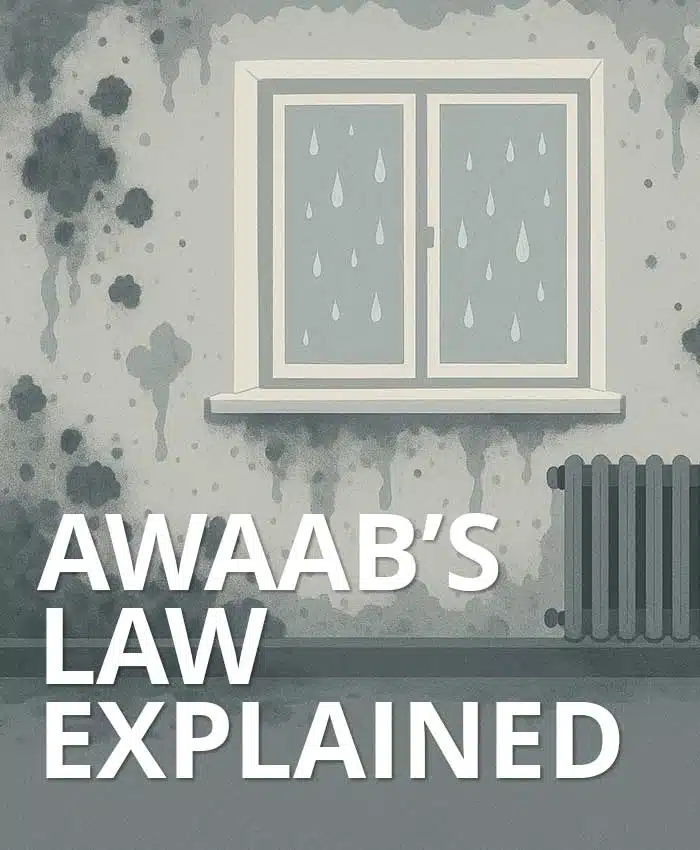
Awaab’s Law is a new UK housing rule that takes effect from October 2025.
It’s called Awaab’s Law in memory of Awaab Ishak, a two-year-old boy who tragically died in 2020 from a respiratory condition caused by mould exposure in his family’s social housing.
The legal case highlighted serious failings – his parents had repeatedly reported the mould, but the landlord did not take action.
As a result, the UK government introduced Awaab’s Law to make sure this never happens again – forcing social landlords to fix damp and mould problems within strict time limits and keep homes safe and healthy.
What the Law Says
Social landlords must:
- Investigate any reported hazard within 10 working days of becoming aware of it.
- Provide tenants with a written summary of findings within 3 working days after the investigation ends.
- Make the home safe using temporary or emergency measures within 5 working days of the investigation ending.
- Begin or take steps to begin full repair work within 5 working days
- (and no later than 12 weeks if unavoidable delays occur).
- Complete all repairs within a reasonable timeframe, without unnecessary delays.
- Investigate and act on emergency hazards within 24 hours to remove immediate risks.
- Provide suitable temporary accommodation if the home cannot be made safe within 5 days
- Or within 24 hours for emergencies.
Although Awaab’s Law currently applies to social housing, it highlights a nationwide issue affecting private rentals and homeowners too. The government has signalled that similar rules may soon extend to the private rental sector, making proper ventilation essential for all landlords.
Poor ventilation and trapped moisture are the main causes of damp and mould, so prevention is always better than cure.
How Ventilation Helps Prevent Damp & Mould
Damp and mould form when everyday moisture from cooking, bathing, or drying clothes indoors becomes trapped inside the property with no way to escape. Over time, this excess humidity settles on cold walls and windows, creating the perfect conditions for mould to grow.
Good ventilation prevents this by removing moist, stale air and replacing it with fresh, filtered air from outside. This not only keeps walls, ceilings, and furnishings dry but also protects tenants’ respiratory health and helps maintain a safer, healthier living environment. Consistent airflow reduces condensation, prevents mould spores from spreading, and protects the property from long-term damp damage.
📞 How do I know which ventilation product I need?
It depends on the size and use of each room, and whether it’s a bathroom, kitchen, or another area.
Our team can help you choose the right solution – just tell us a bit about your property and the issues you’re facing.
👉 Call us today 020 3621 0566 (Mon to Fri 8am to 5:30pm | Sat 9am to 12pm)
👉 Write to us Submit Online Query
📞 Need Help Choosing the Right Solution?
👉 Call us today 020 8463 9696 (Mon to Fri 8am to 5:30pm)
👉 Write to us Submit Online Query
Ventilation Solutions to Help Prevent Damp & Mould
If you’re a landlord or housing provider, here are some practical ways to comply with Awaab’s Law and reduce the risk of damp and mould.
Every property is different, but these ventilation solutions are proven to prevent and reduce condensation – the main cause of mould and damp in homes.
1. Extractor Fans (Bathrooms & Kitchens)
Bathroom fans are the quickest and easiest to install or replace if one already exists – usually within an hour.
For best results, use a humidity-sensing fan with continuous extraction, so it automatically removes excess moisture without tenant input.
In-line fans can also provide effective extraction for both bathrooms and kitchens, offering a quiet and powerful ventilation option.
Kitchen fans or a proper cooker hood will also prevent steam and grease build-up from cooking, reducing condensation across the home.
- 💡 Tip for landlords: Humidity sensor fans switch on automatically when moisture rises.
- 🔧 Fixes: Everyday condensation and humidity in bathrooms and kitchens.
- 🧱 Installation: Low effort – direct replacement or simple wall/window vent.
2. Positive Input Ventilation (PIV) Units
PIVs are whole-house solutions that use one central fan (usually fitted in the loft) to push filtered air through the property.
They only need a single ceiling vent and access to a power supply – making them one of the easiest full-home upgrades for landlords.
For flats or properties without lofts, Flatmaster units are designed for internal installation.
- 💡 Tip for landlords: Choose a heated PIV unit to prevent cold air draughts and tenant discomfort.
- 🔧 Fixes: Persistent mould and stale air throughout the home.
- 🧱 Installation: Moderate single vent and power connection, minimal disruption.
3. Mechanical Extract Ventilation (MEV) & Heat Recovery (MVHR)
These are the most comprehensive and efficient long-term solutions. MEV systems extract stale air from multiple rooms and exhaust it outside; MVHR units also recover heat from outgoing air to warm the incoming supply.
They require ducting runs to several rooms, so they’re best installed during renovations or refurbishments. Once fitted, they automatically keep the property ventilated year-round.
MEV systems are simpler to install, with most work carried out in the loft when extracting from multiple bathrooms and en-suites.
- 💡 Tip for landlords: Best during renovations or between tenancies to avoid disruption.
- 🔧 Fixes: Whole-house condensation, persistent mould, and poor air quality.
- 🧱 Installation: Multi-room ducting, best during medium / major works.
4. Mould Treatment & Prevention Kits
Before installing new ventilation, treat existing mould to stop it spreading.
Products like Kair Anti-Mould Paint create a protective surface that resists regrowth – ideal for bathroom ceilings, kitchen walls, and corners.
You can also mix Kair Anti-Mould Additive into standard paint to protect other rooms in the property.
- 💡 Tip for landlords: Use hygrometers to find humidity hotspots and improve ventilation.
- Ideal is 50% humidity (40%-60%)
- 🔧 Fixes: Existing surface mould and future regrowth.
- 🧱 Installation: Simple DIY or maintenance task – paint or spray on affected areas.
5. Ducting & Grilles
All ventilation systems need good ducting to work effectively.
We supply all kinds of ducting including round and rectangular plastic ducting and flexible ducting in multiple sizes to fit between walls or ceiling spaces, along with grilles and diffusers for neat finishes.
- 💡 Tip for landlords: Match duct size to fan airflow for best results.
- 🔧 Fixes: Poor airflow or weak fan performance.
- 🧱 Installation: Simple for single runs; moderate for full-system replacements.
💡 Pro tip for Landlords
Many modern ventilation units include timers or remote sensors that track how long the system has been running, allowing landlords to check if a unit has been switched off by a tenant. These features help ensure consistent operation and continuous extraction, reducing the risk of damp and mould. Some models also include tamper-proof controls to prevent settings from being changed or the unit from being disabled.
Final Thoughts
Awaab’s Law reminds us that safe, healthy homes start with good air quality.
Whether you’re a social landlord under new compliance rules or a homeowner trying to prevent mould, ventilation is the key.
At i-sells.co.uk, we supply everything you need to stay compliant and mould-free – from extractor fans and ducting to complete PIV and MVHR systems.
👉 Explore our full range today or contact us for advice on the best solution for your property.
📞 Need Help Choosing the Right Solution?
Every property is different, and the right solution for condensation, mould, or damp will depend on the building layout and budget. If you’re a social landlord or installer unsure which system best meets your needs, our team can help you choose compliant, effective ventilation to create healthier homes for tenants.
👉 Call us today 020 3621 0566 (Mon to Fri 8am to 5:30pm | Sat 9am to 12pm)
👉 Write to us Submit Online Query
📞 Need Help Choosing the Right Solution?
👉 Call us today 020 8463 9696 (Mon to Fri 8am to 5:30pm)
👉 Write to us Submit Online Query